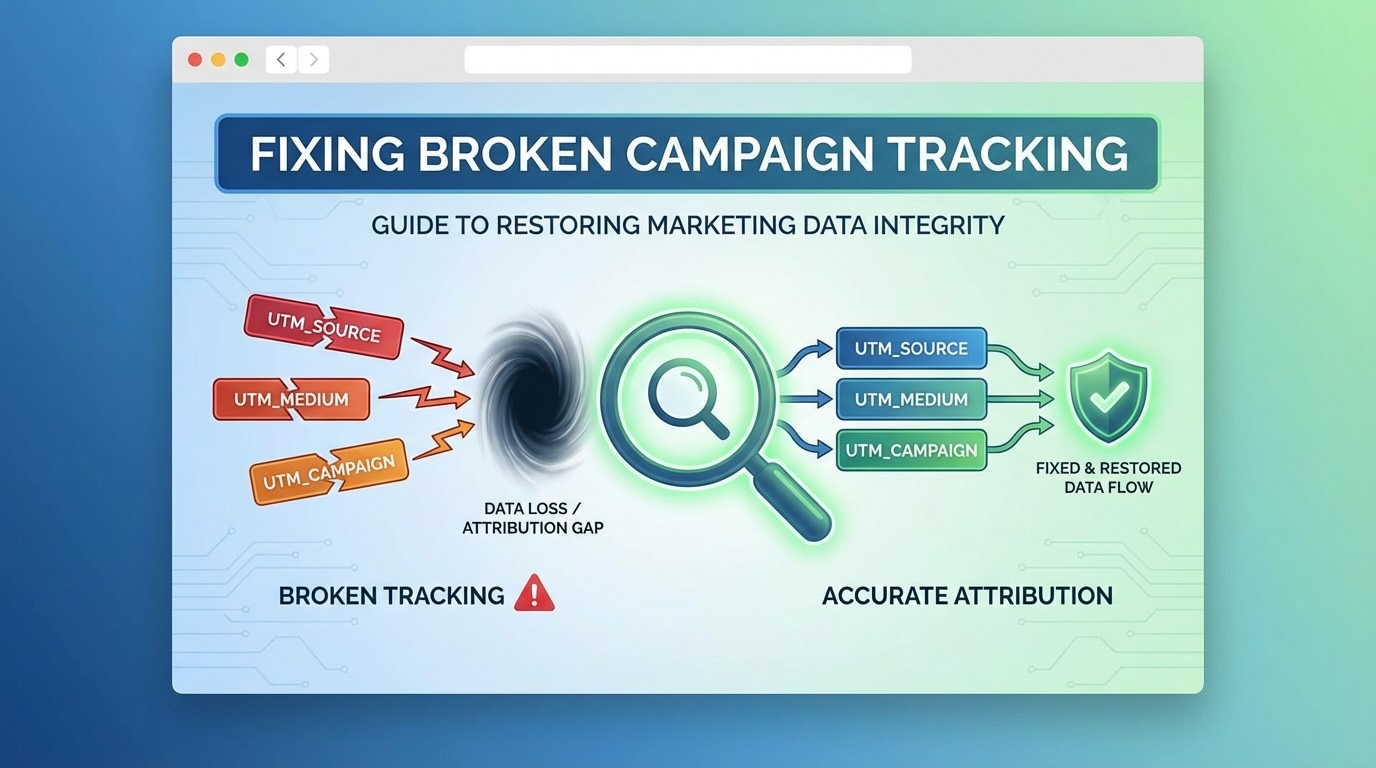
Broken UTM tracking causes up to 35% data loss in campaign attribution, costing UK businesses an average of £25,000-£60,000 annually in misallocated marketing spend. Here’s what most businesses get wrong about campaign tracking – and the 30-minute fix that changes everything.
The £50K Question Every Marketing Director Should Ask
Your Facebook campaigns just delivered 2,000 clicks last month. Your Google Ads drove 1,500. Your email newsletter generated 800 visits. Sales are up 15%.
Which channel deserves credit?
If you answered “I don’t know” or “all of them, proportionally” – congratulations, you’re honest. You’re also flying blind with your marketing budget.
This isn’t your fault. It’s a tracking problem masquerading as a marketing problem. And it’s costing UK businesses between £25,000 and £60,000 annually in wasted spend.
The Invisible Tax on Your Marketing Budget
Here’s what’s happening when your campaign tracking breaks down:
The Data Loss Crisis: Research from CXL Institute reveals that flawed UTM implementation leads to data losses of up to 35% in campaign attribution. That’s more than one-third of your marketing performance vanishing into the “Direct / None” black hole in Google Analytics.
The Misallocation Epidemic: According to Proxima’s research, up to 60% of marketing budgets are wasted due to inefficiencies in execution and planning – with poor attribution at the heart of the problem. When you can’t accurately track which campaigns drive results, you optimise based on incomplete data.
The Real Cost: For a business spending £100,000 annually on marketing, broken tracking could mean £25,000-£35,000 in misallocated budget. You’re not just losing visibility – you’re actively funding underperforming channels whilst starving your winners.
Why Your Tracking Is Probably Broken (Even If You Think It's Fine)
Let’s be honest: most businesses don’t realise their tracking is broken until it’s too late. Here are the warning signs you’re flying blind:
1. The “Direct / None” Mystery
You check Google Analytics and 40% of your conversions are attributed to “Direct / None.” Sounds plausible – people type your URL directly, right?
Wrong.
That massive “Direct / None” bucket typically includes:
- Email campaigns you forgot to tag
- Social posts with missing UTMs
- Affiliate links without tracking
- Paid campaigns with inconsistent parameters
- Internal navigation errors overwriting original sources
Reality check: If more than 15-20% of your traffic shows as “Direct / None,” you have a tracking problem.
2. The Case-Sensitivity Issues
Your analytics shows separate entries for:
- Facebook (327 visits)
- facebook (284 visits)
- FACEBOOK (156 visits)
- fb (203 visits)
That’s not four traffic sources. That’s one platform fragmented across four rows because someone didn’t standardise naming conventions. According to Analytics Mania, this single mistake splits campaign data and makes aggregation impossible.
The Fix: Always use lowercase. Always. utm_source=facebook not utm_source=Facebook.
3. The Internal Link Problem
Someone on your team added UTM parameters to your main navigation. Or your email signature. Or internal promotional banners.
Congratulations – you’ve just corrupted your entire attribution model.
When users click internal links with UTM parameters, Google Analytics ends the current session and starts a new one, overwriting the original traffic source. That organic search visitor who navigated to your pricing page? Now they appear as a newsletter subscriber in your reports.
The Rule: UTM parameters are for external traffic ONLY. Never tag internal site links.
4. The “Set and Forget” Syndrome
Your team launched campaigns six months ago with properly tagged links. Nobody’s checked them since. Meanwhile:
- Redirects have stripped UTM parameters
- Landing page URLs changed
- Platform auto-tagging conflicts with manual UTMs
- Campaign naming evolved but tracking didn’t
According to Ruler Analytics, 70% of businesses now struggle to act on the insights they gain from attribution – often because the data itself is unreliable.
The Real Cost of Broken Attribution
Poor campaign tracking doesn’t just mean messy reports. It creates a cascade of expensive business problems:
Misallocated Budgets
You’re pouring money into channels that appear to perform well but actually contribute little. Or worse – you’re cutting budgets from high-performing channels because they’re not getting proper credit.
Case Study: An e-commerce client was spending £15,000 monthly on Facebook Ads with a reported £45,000 return (3X ROAS). After fixing their tracking, they discovered the actual return was £22,500 (1.5X ROAS). They’d been using last-click attribution and missing that most Facebook visitors converted days later through direct visits.
Campaign Optimisation Theatre
You’re testing ad copy, adjusting bids, and tweaking targeting – all based on incomplete data. It’s like optimising your route with a broken compass.
The LOCALiQ UK State of Digital Marketing Report 2025 found that only 26% of marketing professionals rate themselves as “extremely satisfied” with campaign performance. Poor attribution is a primary culprit.
Sales Team Friction
Marketing reports 500 qualified leads monthly. Sales claims they received 200 garbage leads and 50 decent ones. Who’s right?
Both – because your tracking doesn’t show which campaigns drive quality leads versus tyre-kickers.
Lost Strategic Clarity
Without proper attribution, you can’t answer basic questions like:
- Which campaigns have the shortest sales cycles?
- What’s the true customer acquisition cost by channel?
- Which touchpoints assist conversions versus driving them?
The 30-Minute Fix That Changes Everything
Fixing campaign tracking isn’t a six-month analytics transformation project. It’s a focused 30-minute exercise in establishing standards.
Step 1: Create Your UTM Naming Convention (10 minutes)
Create a spreadsheet. Create three columns: Parameter, Purpose, Allowed Values.
utm_source (Where):
- google, facebook, linkedin, newsletter, twitter, instagram
- Rule: All lowercase, platform-specific
utm_medium (How):
- cpc, paid-social, email, organic-social, referral, display
- Rule: Matches GA4 channel groupings
utm_campaign (What):
- Format: {year}-{quarter}-{offer}-{audience}
- Example: 2026-q1-webinar-mmm-leads
- Rule: Descriptive, date-prefixed, hyphen-separated
Optional utm_content (Which):
- For A/B testing variations
- Format: {variation}-{element}
- Example: variant-a-headline or cta-blue-button
Save this document. Share it with your team. Make it non-negotiable.
Step 2: Audit Your Current Campaigns (10 minutes)
Pull a report of all utm_source and utm_medium values from the last 90 days. Look for:
- Case inconsistencies (Facebook vs facebook)
- Typos (twtter, gooogle, lnkedin)
- Missing campaigns (large Direct traffic spikes)
- Internal link contamination (homepage clicks appearing as campaigns)
Flag everything that doesn’t match your new convention.
Step 3: Implement Automated Tagging (10 minutes)
Stop manually adding UTM parameters to every link. Use tools that enforce your standards:
- For email: Most platforms (Mailchimp, HubSpot, ActiveCampaign) auto-tag links
- For social: Use a UTM builder or Bit.ly with campaign templates
- For paid ads: Configure auto-tagging but add manual UTMs as backup
The goal: Make it impossible to create untagged or incorrectly tagged links.
Advanced Tracking for Serious Businesses
Once your foundation is solid, level up with these pro moves:
Unified Tracking Across Platforms
Your customer doesn’t distinguish between “the Facebook campaign” and “the Google campaign.” They experience your brand holistically. Your tracking should reflect this.
Consider integrating:
- CRM-level attribution (connecting clicks to closed deals)
- Server-side tracking (bypassing ad blockers affecting 42.7% of users)
- Cross-device tracking (that Facebook click on mobile might convert on desktop)
Attribution Modelling Beyond Last-Click
Last-click attribution is like crediting the striker for a goal whilst ignoring the midfielder who made the perfect pass and the defender who started the play.
Explore:
- First-click: What introduced them to your brand?
- Linear: Equal credit to all touchpoints
- Time-decay: More credit to recent interactions
- Data-driven (GA4): Machine learning-based attribution
Or go further with Marketing Mix Modelling (MMM) for true causal analysis of marketing effectiveness.
Post-Click Behaviour Tracking
Campaign clicks tell you traffic volume. Post-click behaviour tells you quality.
Track:
- Time on site by campaign source
- Pages per session by medium
- Conversion rate by campaign
- Customer lifetime value by first-touch source
This reveals which campaigns drive genuinely valuable visitors versus vanity traffic.
Common Objections (And Why They're Wrong)
“We use Google Ads auto-tagging, so we’re fine.”
Auto-tagging only works for Google Ads, only within Google Analytics, and only if nothing conflicts with it. What about Facebook, LinkedIn, email, and everything else? Auto-tagging isn’t a strategy – it’s one tool in a comprehensive approach.
“UTM links look ugly and reduce click-through rates.”
Use a link shortener. Bit.ly, your own branded domain, or UTM.io all turn yoursite.com/pricing?utm_source=facebook&utm_medium=paid-social&utm_campaign=2026-q1-mmm-awareness into yoursite.link/pricing-fb. Clean URLs, complete tracking.
“We’re too small to need sophisticated tracking.”
If you’re spending money on marketing, you need tracking. A £5,000 monthly budget with 35% data loss costs £21,000 annually in misallocation. That’s not small.
“Our agency handles the tracking.”
Brilliant! Ask them:
- To share their UTM naming convention document
- For a report showing no case inconsistencies or typos in the last 90 days
- What percentage of your traffic shows as “Direct / None”
If they can’t answer immediately, your agency has a tracking problem.
The WebIQ Analytics Difference: Tracking That Actually Works
At WebIQ Analytics, we’ve seen this play out hundreds of times: businesses spending £50,000-£500,000 on marketing with no reliable way to measure what works.
Our approach:
Comprehensive Audit: We examine your entire tracking infrastructure – UTMs, GA4 configuration, conversion tracking, attribution settings – and identify every gap.
Standards Implementation: We create your custom UTM framework, configure automated tagging, and eliminate human error from the process.
Attribution Strategy: We go beyond basic UTM tracking to implement proper attribution modelling, connecting marketing activity to actual revenue.
Ongoing Governance: We conduct quarterly tracking audits, train your team on standards, and ensure tracking accuracy as your marketing evolves.
Most importantly, we fix the foundations before we touch campaign optimisation. Because optimising campaigns with broken tracking is like renovating a house with a cracked foundation – waste of money, waste of time.
Your Next Step
You have three options:
- Continue as-is: Keep spending marketing budget whilst 35% of performance data disappears into “Direct / None”
- DIY fix: Spend 30 minutes today implementing the standards above (genuinely effective for smaller teams)
- Professional audit: Get WebIQ Analytics to comprehensively review your tracking, identify gaps, and implement enterprise-grade attribution
The worst option is knowing you have a tracking problem and doing nothing about it.
The Bottom Line
Your campaigns probably are working. Your SEO is driving qualified traffic. Your paid social is generating awareness. Your email is nurturing prospects.
But you’ll never optimise effectively, prove ROI confidently, or allocate budget intelligently until your tracking works properly.
Start with the 30-minute fix. Implement naming standards. Audit your current campaigns. Automate wherever possible.
Then, when you’re ready for advanced attribution that connects marketing spend to actual revenue, book a discovery call with WebIQ Analytics. We’ll show you exactly where your tracking breaks down – and how to fix it permanently.
Because the only thing worse than bad marketing is good marketing you can’t measure.