Companies without proper marketing attribution models misallocate up to 30% of their marketing budget—that’s £30,000 wasted for every £100,000 spent. Here’s why your reports show Facebook “isn’t working” whilst sales collapse when you pause it, and the measurement framework that actually reveals truth.
The Facebook Paradox Every Business Owner Recognises
You pause your Facebook advertising to cut costs. Within 48 hours, sales drop 40%.
But here’s the confusing part: your marketing reports said Facebook wasn’t working. Last-click attribution showed most conversions coming from Google, branded search, and direct traffic. Facebook appeared to be burning money with minimal return.
So which is it? Are the sales telling you Facebook works, or are the reports telling you it doesn’t?
The answer: your reports are lying to you. And this lie is costing UK businesses between £25,000 and £60,000 annually in misallocated marketing spend.
The £30,000 Misallocation Tax
Here’s what’s actually happening in your marketing measurement:
The Data: Research from the Digital Marketing Institute reveals that companies without proper marketing attribution models commonly misallocate up to 30% of their marketing budget. That’s not a rounding error—that’s systematic budget destruction.
The Reality: For a business spending £100,000 annually on marketing, broken attribution means £30,000 going to underperforming channels whilst your actual drivers are starved of investment.
The Scale: 61% of UK businesses cut their marketing budgets in the past 12 months, according to LOCALiQ research. But how many of those cuts targeted the wrong channels because their reports were fundamentally broken?
Why Attribution Lies (And Why Nobody Tells You)
Most marketing reports use last-click attribution by default. It’s simple, measurable, and completely misleading.
The Last-Click Delusion
Last-click attribution gives 100% of the credit to the final touchpoint before purchase. Here’s why that’s catastrophic:
Real Customer Journey:
- Monday: Sees Facebook ad for your product → Thinks “interesting” → Doesn’t buy
- Wednesday: Sees Instagram post → Visits site → Browses → Leaves
- Friday: Remembers your brand → Googles “[your brand] reviews” → Reads content → Still thinking
- Sunday: Types your URL directly → Purchases
What Last-Click Reports: Direct traffic gets 100% credit. Facebook, Instagram, and Google organic get nothing.
What You Conclude: “Facebook isn’t working. Cut the budget.”
What Actually Happens: Facebook introduced them to your brand. You just eliminated your primary customer acquisition channel based on a lie.
The Brutal Statistics on Broken Attribution
Let’s examine what the research actually shows about marketing attribution in 2025:
38% of marketers say attribution is their #1 analytics challenge (Marketing LTB, 2025)
22% of organisations still rely exclusively on last-click attribution (Marketing LTB, 2025)
70% of businesses struggle to act on the insights they gain from attribution (Ruler Analytics, 2025)
64% of CMOs say attribution directly influences budgeting decisions (Marketing LTB, 2025)
Think about that last statistic. Nearly two-thirds of marketing budget decisions are influenced by attribution data—and 22% of those decisions are based on demonstrably broken last-click models.
That’s not measurement. That’s expensive guesswork dressed up as data.
The Hidden Cost: What Broken Attribution Actually Destroys
Poor marketing attribution doesn’t just mean messy reports. It creates a cascade of expensive business problems:
1. Misallocated Budgets
You’re overfunding channels that appear to perform well (because they get last-click credit) whilst underfunding the channels that actually introduce customers to your brand.
Real Example: A SaaS company was spending £8,000 monthly on content marketing and £15,000 on Google Ads. Last-click attribution showed Google driving 73% of conversions.
After implementing proper multi-touch attribution, they discovered content marketing influenced 81% of their highest-value customers—it just rarely got final-click credit because customers would Google the brand name weeks after reading content.
They were dramatically underfunding their best channel.
2. Channel Conflict and Poor Integration
When channels compete for last-click credit rather than working together, you get:
- Sales teams claiming marketing leads are rubbish
- Content teams unable to prove ROI
- Paid media teams stealing credit from organic
- Email marketers claiming all remarketing success
Everyone’s optimising their piece whilst the whole system underperforms.
3. Inability to Prove ROI
According to Ruler Analytics, 53.3% of marketers cite “minimal understanding” as the main challenge of effective marketing attribution. When you can’t accurately measure, you can’t prove value.
The result? Marketing budgets get cut first during economic uncertainty—even when marketing is actually working.
4. Strategic Decisions Based on Fiction
You’re making six-figure budget allocation decisions based on fundamentally broken data. That’s not strategy—that’s expensive gambling.
Why Last-Click Attribution Persists (When Everyone Knows It’s Wrong)
If last-click attribution is so obviously broken, why does 22% of the market still use it exclusively?
Because it’s simple. It’s the analytics equivalent of “just weigh yourself” for health tracking. Easy to measure, easy to report, completely insufficient for actual decision-making.
Because it’s default. Google Analytics has historically defaulted to last-click. Most businesses never question it.
Because multi-touch is “complicated.” Actually, it’s not—but it requires slightly more setup than accepting defaults.
Because agencies like it. If you’re a search agency, last-click attribution makes your channel look brilliant. Why would you advocate for measurement that might reveal you’re getting credit for demand other channels created?
What Good Attribution Actually Looks Like
Proper marketing attribution doesn’t require a PhD in econometrics. It requires understanding three things:
1. Customer Journeys Aren’t Linear
Research shows that 55% of paid social conversions require 3+ touches to close. Your customer doesn’t see one ad and buy. They:
- See awareness content (social, display, content marketing)
- Engage with consideration content (blog posts, case studies, comparisons)
- Search for your brand specifically
- Convert through direct visit or branded search
Each touchpoint matters. Last-click only sees the final step.
2. Different Channels Serve Different Roles
- Top-of-funnel channels (social, display, content) introduce people to your brand
- Mid-funnel channels (email, retargeting, organic search) nurture consideration
- Bottom-funnel channels (branded search, direct, retargeting) close sales
Judging Facebook by last-click is like blaming the striker who made the perfect pass because they didn’t score the goal themselves.
3. Attribution Models Should Match Your Reality
First-Touch Attribution: Credits the channel that introduced the customer
- Good for: Understanding customer acquisition sources
- Limitation: Ignores everything that happened after introduction
Linear Attribution: Equal credit to all touchpoints
- Good for: Recognising that every interaction matters
- Limitation: Doesn’t distinguish between influence levels
Time-Decay Attribution: More credit to recent interactions
- Good for: B2B with longer sales cycles where recent touches matter more
- Limitation: Undervalues early awareness
Data-Driven Attribution (GA4): Machine learning assigns credit based on actual conversion patterns
- Good for: Large data sets, complex journeys
- Limitation: Requires significant traffic volume, can be “black box”
Marketing Mix Modelling (MMM): Statistical analysis of overall marketing effectiveness
- Good for: Understanding true causal impact, including offline channels
- Limitation: Requires specialist knowledge, doesn’t provide granular campaign insights
The Framework That Actually Works
Here’s how businesses with 15-30% higher marketing ROI (per Gartner research) actually measure attribution:
Step 1: Acknowledge the Truth
Your current attribution is probably broken. That’s not a criticism—it’s just reality. According to Marketing LTB research, companies that switch from single-touch to multi-touch attribution see an average 22% increase in budget efficiency.
Step 2: Implement Multi-Touch Tracking
At minimum, move from last-click to time-decay or linear attribution in Google Analytics 4. This is a settings change, not a six-month project.
How:
- Go to GA4 Admin → Attribution Settings
- Switch from “Last Click” to “Data-Driven” (if you have sufficient traffic) or “Time Decay”
- Compare reports under “Advertising → Attribution” to see the difference
You’ll immediately see channels that were invisible in last-click suddenly showing value.
Step 3: Track the Full Customer Journey
Connect your data sources:
- CRM (to see which marketing touches led to actual sales)
- Email platform (to credit nurture campaigns)
- Advertising platforms (to see assisted conversions, not just last-click)
Tools like HubSpot, Ruler Analytics, or even well-configured GA4 can show you the complete path to purchase, not just the final step.
Step 4: Ask Different Questions
Instead of “which channel drove the most conversions?” ask:
- Which channels introduce high-value customers to our brand?
- Which content assists conversions even if it doesn’t get last-click credit?
- What’s the typical customer journey from awareness to purchase?
- Which combinations of channels work together to drive sales?
These questions reveal how your marketing actually works, not just which channel got lucky with the final click.
Step 5: Consider Marketing Mix Modelling for Scale
Once you’re spending £100K+ annually on marketing, proper Marketing Mix Modelling (MMM) becomes cost-effective. MMM uses statistical analysis to determine true causal relationships between marketing spend and business outcomes.
MMM reveals:
- Which channels have diminishing returns (so you know when to stop increasing spend)
- How different channels interact (social + search might be 30% more effective together than separately)
- External factors impacting performance (seasonality, competition, market conditions)
- True incrementality (what would happen if you cut a channel)
Companies using MMM effectively see 25-35% improvements in marketing efficiency according to Forrester research.
The WebIQ Approach: Truth Before Tactics
At WebIQ Analytics, we’ve audited hundreds of marketing attribution setups. Here’s what we consistently find:
The Problem Pattern:
- Business relies on default last-click attribution
- Reports show certain channels “not working”
- Budget gets reallocated based on broken data
- Actual performance deteriorates
- More budget cuts follow
- Marketing effectiveness collapses
The Solution:
- Comprehensive attribution audit (reveals where measurement breaks down)
- Multi-touch attribution implementation (shows the real customer journey)
- Channel interaction analysis (reveals how marketing works together)
- Marketing Mix Modelling for businesses at scale (quantifies true causal impact)
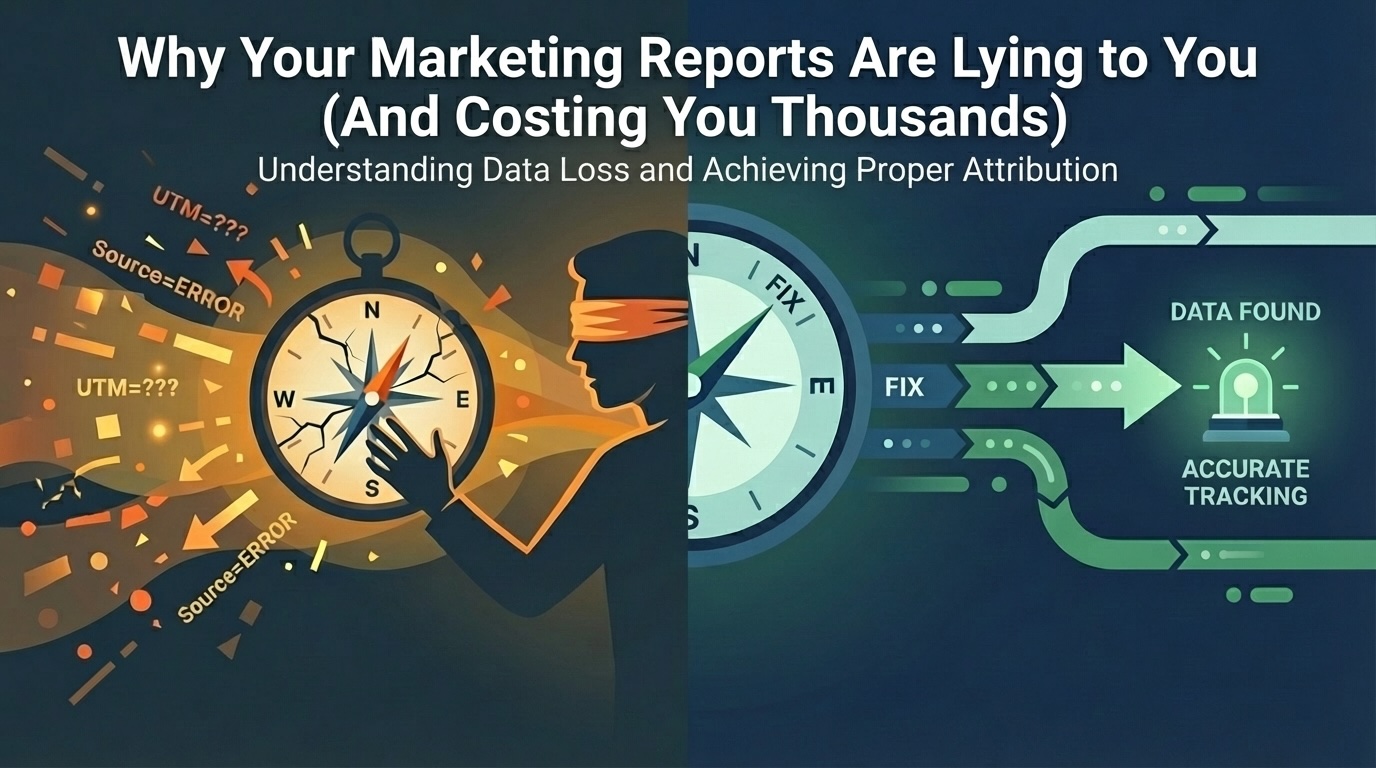
We don’t touch campaign optimisation until attribution is fixed. Because optimising campaigns based on broken measurement is like trying to navigate with a broken compass – more effort just gets you more lost.
The Questions You Should Be Asking Right Now
“How much of our budget is currently misallocated?”
If you’re using last-click attribution exclusively, research suggests up to 30% misallocation is likely. For a £100K marketing budget, that’s potentially £30,000 in waste.
“Which of our channels are actually working?”
You won’t know until attribution is fixed. That “underperforming” Facebook campaign might be your primary customer acquisition source.
“What would proper attribution cost us to implement?”
Multi-touch attribution in GA4: Free, takes 15 minutes to configure. Attribution software (HubSpot, Ruler, etc.): £200-£2,000/month depending on scale. Marketing Mix Modelling: £8,000-£25,000 for initial setup, then monthly retainers.
“What’s it costing us NOT to fix attribution?”
For every month you operate with broken attribution, you’re systematically misallocating budget. Even a 10% improvement in marketing efficiency pays for proper attribution within weeks.
Your Next Step
You have three options:
Option 1: Keep Operating Blind Continue making six-figure marketing decisions based on last-click attribution. Hope you’re getting lucky with budget allocation.
Option 2: Fix It Yourself Switch to multi-touch attribution in GA4 (15-minute settings change). Start tracking the full customer journey. Implement proper tagging and cross-platform tracking.
Option 3: Get Professional Attribution Analysis Work with specialists who implement proper attribution frameworks, reveal your true marketing performance, and quantify exactly where your budget should go.
The worst option is knowing your attribution is broken and doing nothing about it.
The Bottom Line
Your marketing probably IS working. Your reports just can’t see it.
When attribution is broken:
- Facebook gets zero credit for introducing customers
- Content marketing looks like a cost centre
- Email nurture campaigns appear worthless
- Budget goes to whoever gets lucky with the last click
When attribution is fixed:
- You see which channels actually drive customer acquisition
- Budget allocation matches reality, not measurement artefacts
- Channel teams work together instead of competing for credit
- Marketing efficiency improves 15-30% without spending more
The question isn’t whether you can afford to fix attribution. It’s whether you can afford to keep making expensive decisions based on broken data.
Ready to see what your marketing actually does? Book a comprehensive attribution audit with WebIQ. We’ll reveal exactly where your current measurement breaks down and what fixing it would mean for your budget allocation.
Or email hello@webiqanalytics.com to discuss your specific attribution challenges.