

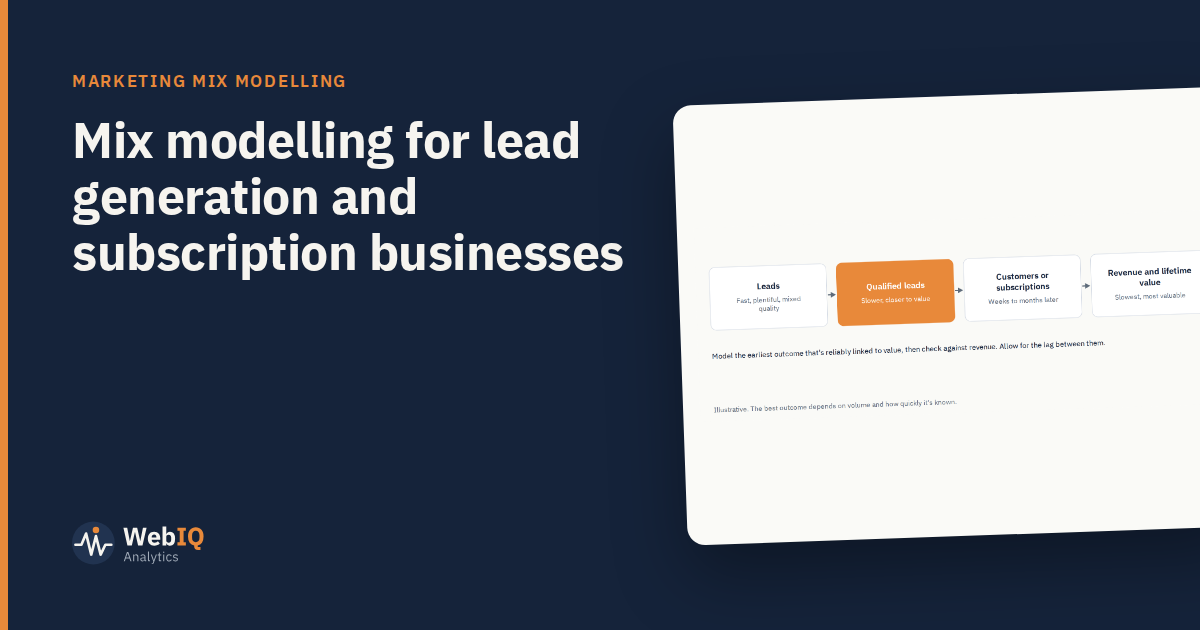
Mix modelling is often described with retail sales as the outcome. Lead generation and subscription businesses (financial services, software, education, utilities) have extra challenges: the valuable outcome arrives weeks or months after the marketing, and many leads never turn into anything.
Choose the outcome carefully
- Leads: plentiful and fast, but quality varies by channel. A model on raw leads may favour channels that produce cheap, poor leads.
- Qualified leads: closer to value and still reasonably fast. Often the best balance.
- Customers or subscriptions: the real outcome, but slower and less frequent.
- Revenue or lifetime value: the most valuable, and the slowest.
Handle the time lag
If qualification or conversion takes weeks, a weekly model of customers will see marketing effects spread over a long period. Options:
- Model the earlier outcome (qualified leads) and apply measured conversion rates by channel to estimate value.
- Date outcomes by the original lead date rather than the conversion date, so effects line up with the marketing.
- Allow longer carryover where the evidence supports it.
Check lead quality by channel
Join CRM outcomes to lead sources, without double counting, and compare conversion rates by channel. If they differ a lot, a model on raw leads will mislead. Use qualified leads, or value-weight the outcome.
Watch for capacity limits
Sales teams have limited capacity. If leads beyond a certain number aren't followed up, extra marketing can look ineffective when the real bottleneck is sales. Include sales capacity or follow-up rates as a control where it varies.
Validate against revenue
Whatever outcome you model, check results against revenue over longer periods. If the channels the model favours don't produce valuable customers, the outcome definition needs revisiting.
Done carefully, mix modelling works well for lead generation and subscription businesses, and often reveals channels that look expensive per lead but cheap per customer.