

Every mix model makes assumptions. A Bayesian model writes them down. Those written assumptions are called priors, and they're one of the most useful, and most misunderstood, parts of modern mix modelling.
What a prior is
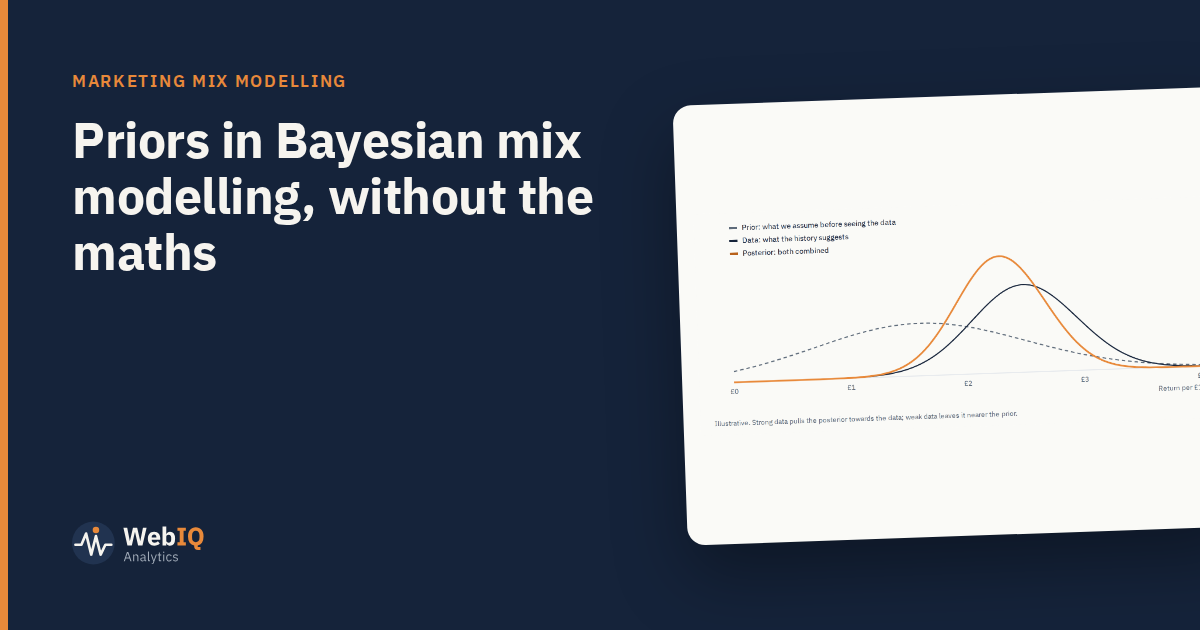
A prior is what the model assumes about something before it sees your data: for example, that a channel's return per £1 is probably between £0 and £5, and more likely nearer £1 than £5. The model then combines that assumption with the data to produce the posterior: an updated range of likely values.
Why this is a strength, not a fudge
- Assumptions are explicit. Non-Bayesian models also make assumptions (which variables to include, how to constrain them), but they're often hidden.
- Uncertainty is honest. When data is weak, results stay close to the prior and the range stays wide. The model doesn't pretend to know more than it does.
- Evidence can be added. Results from geo tests or lift studies can be used as priors, so the model builds on what you already know.
How data and priors interact
When a channel's spend varied a lot, the data dominates and the prior matters little. When spend barely changed, the data says little, and the result stays near the prior. That's why it's essential to know which results are data-driven and which are mostly assumption.
Setting sensible priors
- Start from what's plausible. Returns per £1 can't be negative for most paid media; carryover for search is short; for TV it's longer.
- Use evidence where you have it. A well-run test is the best source of a prior for that channel.
- Keep them wide where you're unsure. A tight prior without evidence forces the answer.
- Write them down and share them with the people who'll use the results.
Questions to ask about any Bayesian model
- What priors were used, and where did they come from?
- Which channels' results moved a long way from their prior, and which barely moved?
- What happens to the results if the priors are widened?
If a result barely changes when the prior changes, the data is driving it. If it moves a lot, treat it as an assumption to test, not a finding to act on.