

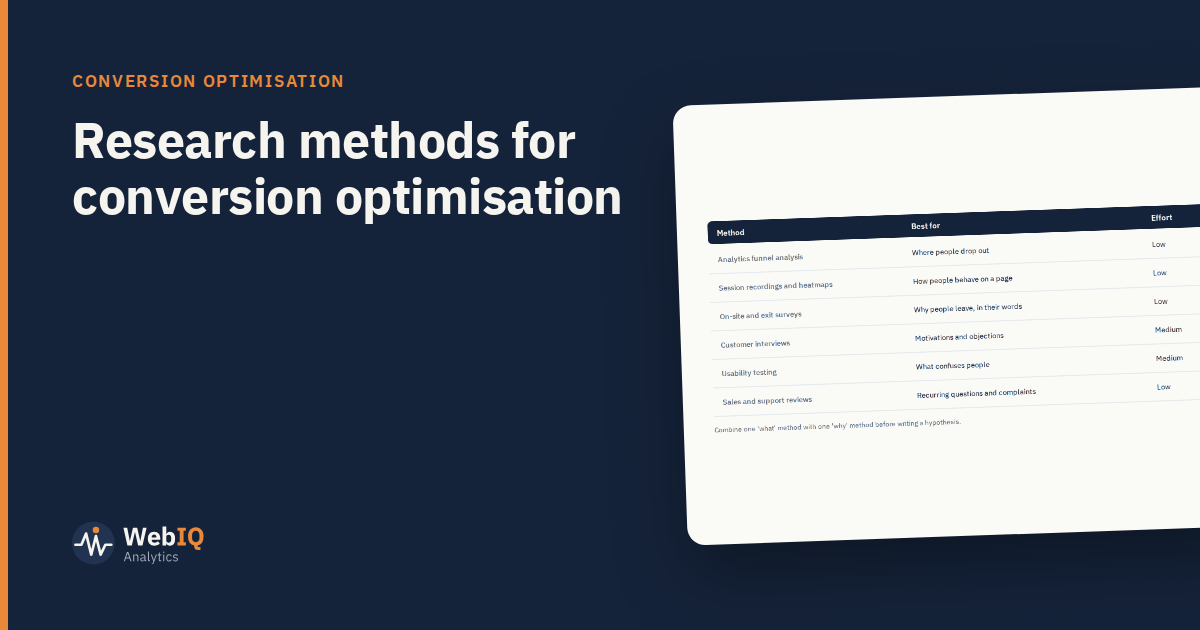
The best test ideas come from research, not brainstorms. Research tells you where people struggle and why, so tests address real problems. Each method answers a different question, and the strongest evidence comes from combining them.
What and why
Research methods fall into two groups:
- What happens: analytics funnels, session recordings and heatmaps. They show where people drop out and how they behave.
- Why it happens: surveys, interviews, usability tests, and sales or support conversations. They explain the behaviour in people's own words.
A good hypothesis usually needs one of each: a measured problem and an explanation.
Choosing methods
- Low traffic or B2B: interviews, usability tests and sales-call reviews often reveal more than analytics.
- High traffic: funnel analysis and recordings find problems quickly; surveys add the reason.
- Before a redesign: usability tests on the current site and a prototype.
- After a failed test: go back to research to understand why.
Practical tips
- Surveys: ask one open question at the point of leaving or just after purchase. "What nearly stopped you buying today?" is a reliable start.
- Recordings: watch with a question in mind, not at random. Tag patterns, then count them.
- Interviews: talk to recent customers and people who nearly bought. Five to eight interviews usually reveal the main themes.
- Usability tests: give realistic tasks and watch without helping.
Turn findings into hypotheses
For each finding, write: the problem, the evidence, how many people it affects, and a proposed change. Score them with your prioritisation method and add them to the backlog.
Keep a research library
Store findings where the whole team can find them, tagged by page and theme. Research keeps its value long after a single test, and stops the same questions being researched twice.