

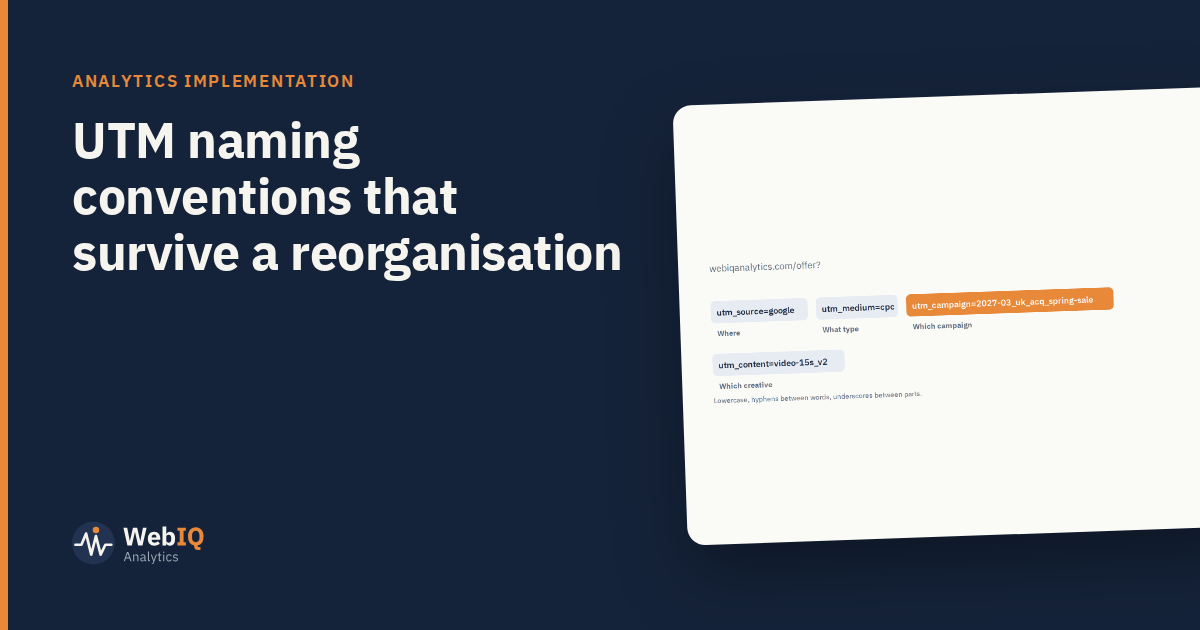
Campaign tags decay. A new agency invents its own names, a team uses capitals, someone tags internal links. A year later, a large share of traffic often sits in "Unassigned" and campaigns can't be compared. A short standard prevents most of it.
The rules
- Lowercase everything. Analytics tools treat
Emailandemailas different values. - Hyphens between words, underscores between parts. No spaces.
- A controlled list for `utm_medium`, chosen to match your analytics tool's channel definitions.
- No personal data in URLs.
- Never tag links between pages of your own site; it restarts the session and overwrites the source.
The parameters
utm_source: where the click came from (google,meta,newsletter).utm_medium: the type of traffic, from the approved list (cpc,paid-social,email,display,affiliate).utm_campaign: a structured name, for exampleyyyy-mm_market_objective_name.utm_content: the creative or variant.utm_term: keyword or audience, when useful.
Why the campaign pattern matters
Putting the launch month first makes names sort by date. Market and objective codes let you group campaigns without a separate lookup. A short, stable name survives rebrands of the campaign itself.
Making it stick
- One owner for the standard.
- A campaign register, a shared sheet of every campaign name, dates and owner.
- Agencies get the standard in onboarding, and tagged links are checked before launch.
- A monthly check of unassigned traffic, fixed at the source rather than in reports.
Check your medium values against your analytics tool's current channel rules. GA4's default channel groups use both source and medium, and Google updates them. For anything the defaults don't cover, such as QR codes, create a custom channel group.