

"Let's test a green button" isn't a hypothesis. It's a guess. A good hypothesis says what you'll change, what you expect to happen, why you expect it, and how you'll decide. Written that way, every test teaches you something, including the ones that don't win.
The format
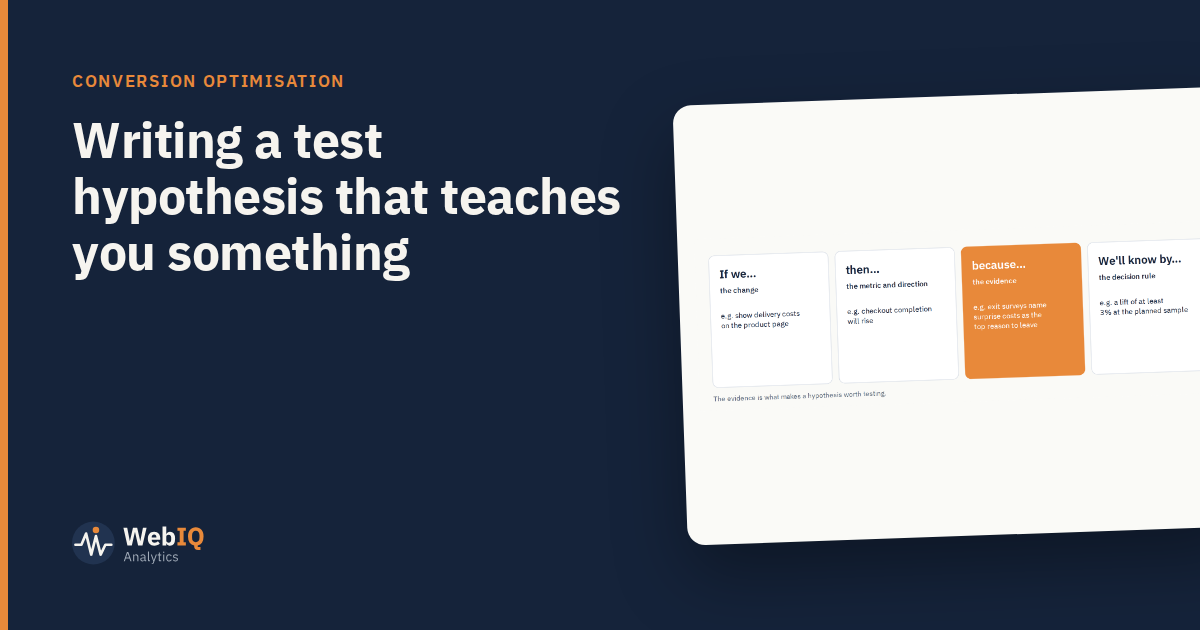
If we [make this change], then [this metric] will [move in this direction], because [this evidence]. We'll know by [this decision rule].
Each part does a job
- If we: specific enough that a designer and developer build the same thing.
- Then: one primary metric, chosen in advance. Secondary metrics can be watched, but the decision rests on the primary one.
- Because: the evidence. Research, analytics, customer feedback, a previous test. Without it, you're testing opinions.
- We'll know by: the smallest effect that matters and the planned sample, so the result can't be reinterpreted afterwards.
Good and weak examples
Weak: "Test a new checkout design to improve conversion."
Strong: "If we show the delivery cost on the product page, then checkout completion will rise, because exit surveys name unexpected delivery costs as the main reason for leaving. We'll know by a lift of at least 3% at the planned sample."
Why the evidence matters most
When a test loses, the evidence tells you what you learned. Either the problem wasn't what you thought, or the solution didn't address it. Both are useful. Without evidence, a losing test teaches nothing.
Keep a record
Log every hypothesis, its evidence and its result in one place. Over time, patterns emerge: which kinds of change work for your audience, and which evidence sources predict wins. That record is the real asset of a testing programme.
A quick check before launch
- Is the change specific?
- Is there one primary metric?
- Is the evidence written down?
- Is the decision rule agreed, and is the test sized to detect it?
If any answer is no, the test isn't ready.