

Many B2B sites get a few thousand visitors a month and a handful of demo requests. Classic A/B testing, sized properly, would take years to detect most effects. That doesn't mean optimisation is impossible. It means using different tools.
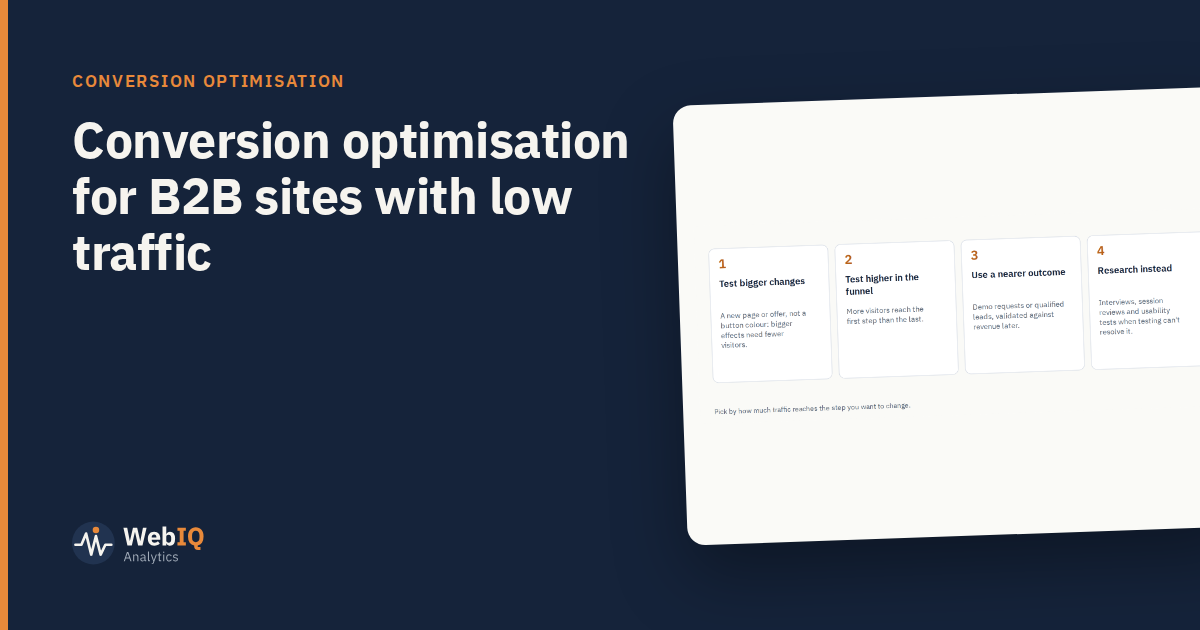
1. Test bigger changes
Small tweaks need huge samples. A new page structure, a different offer or a shorter form produces effects large enough to detect with modest traffic.
2. Test higher in the funnel
More people reach your pricing or product pages than submit a form. Testing engagement with the earlier steps gives faster answers, as long as you check the change doesn't hurt later steps.
3. Use a nearer outcome, carefully
Demo requests or qualified leads arrive faster than closed deals. Use them as the test outcome, but check later that the winning variant didn't just attract less suitable leads.
4. Research instead of testing
Interviews with recent buyers, session recordings, usability tests and sales-call reviews often reveal problems directly. For low-traffic sites, research usually finds more than testing does.
Measuring what matters in B2B
- Connect web behaviour to CRM outcomes: which pages and sources lead to pipeline, not just form fills.
- Watch lead quality, not just volume.
- Use longer windows. B2B buying takes weeks or months; judge changes over the cycle, not the week.
A sensible programme
Research to find problems, a few well-sized tests on high-traffic pages, bigger changes rolled out with before-and-after monitoring, and CRM-linked reporting to check what actually turns into revenue. It's slower than consumer testing, and more honest than declaring winners from tiny samples.