

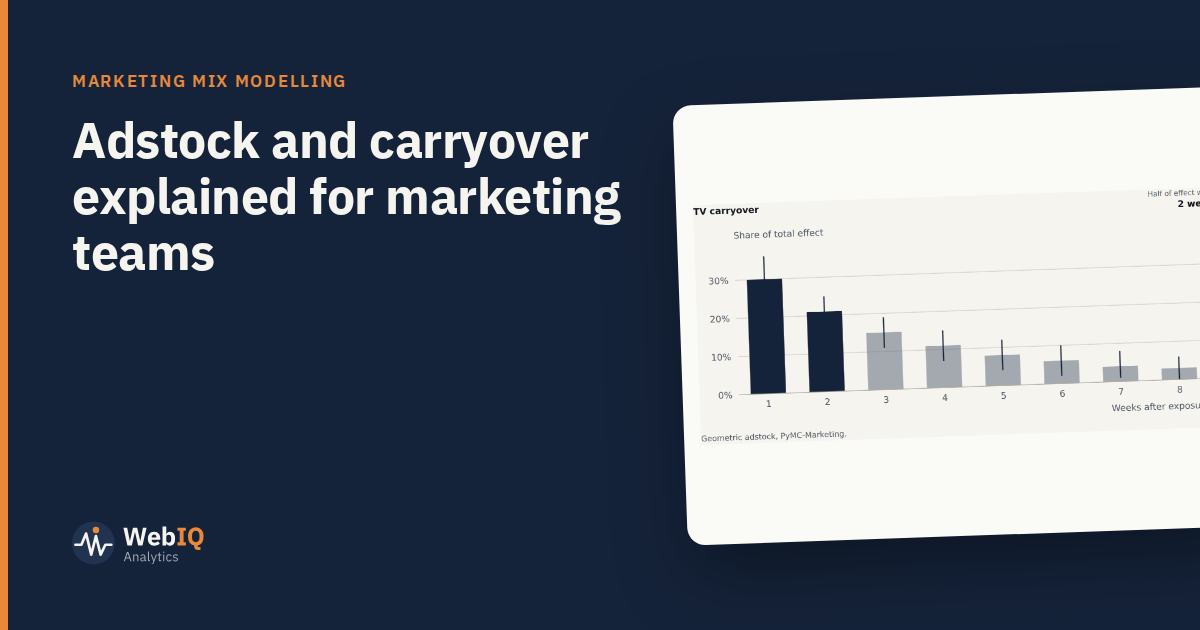
Spend on TV this week and some people buy this week. Others remember the brand next week, or next month, when they're ready. That delayed effect is called carryover, and the way mix models represent it is called adstock.
How adstock works
Adstock turns a channel's weekly spend into a running total of advertising pressure. Each week, the model adds that week's spend to a share of last week's pressure. The share carried forward is the decay rate.
- Low decay (around 0.1 to 0.3): most of the effect happens straight away. Typical of paid search, where people act on intent.
- High decay (around 0.5 to 0.8): the effect builds and fades over weeks. Typical of TV, video, radio and outdoor.
A useful way to describe decay is the half-life: the number of weeks until half the effect has gone.
Why it matters for budget decisions
- Short reporting windows undervalue slow channels. Judged on same-week results, brand channels look weak while most of their effect is still to come.
- Cuts take weeks to show. Switch off a high-carryover channel and sales drift down gradually, which makes the cause easy to miss.
- Forecasts need it. Next quarter starts with carryover from this quarter's spend already in the system.
Shapes beyond simple decay
Simple (geometric) decay assumes the biggest effect comes in the week of spend. Some channels peak later: a cinema campaign, or a TV burst that builds awareness over several weeks. Most modelling tools also offer delayed or more flexible shapes. Use them when there's a reason to expect a delayed peak, not by default.
How the model finds the right decay
In a Bayesian mix model, decay is estimated from the data, starting from a sensible prior for each channel type. The data can only refine it if spend varied enough. A channel that always ran at the same level gives little information about how fast its effect fades.
Questions to ask about carryover in any model
- What decay or half-life was estimated for each channel, and with what range?
- Do the values make sense for the channel? A three-month half-life for paid search is a warning sign.
- How far forward does the model carry effects? Most of the effect should be captured within a few months.
- Are results judged over the period the effect lasts, not just the week of spend?
Carryover isn't a technical detail. It changes which channels look effective, how quickly results appear, and what happens after a cut.