

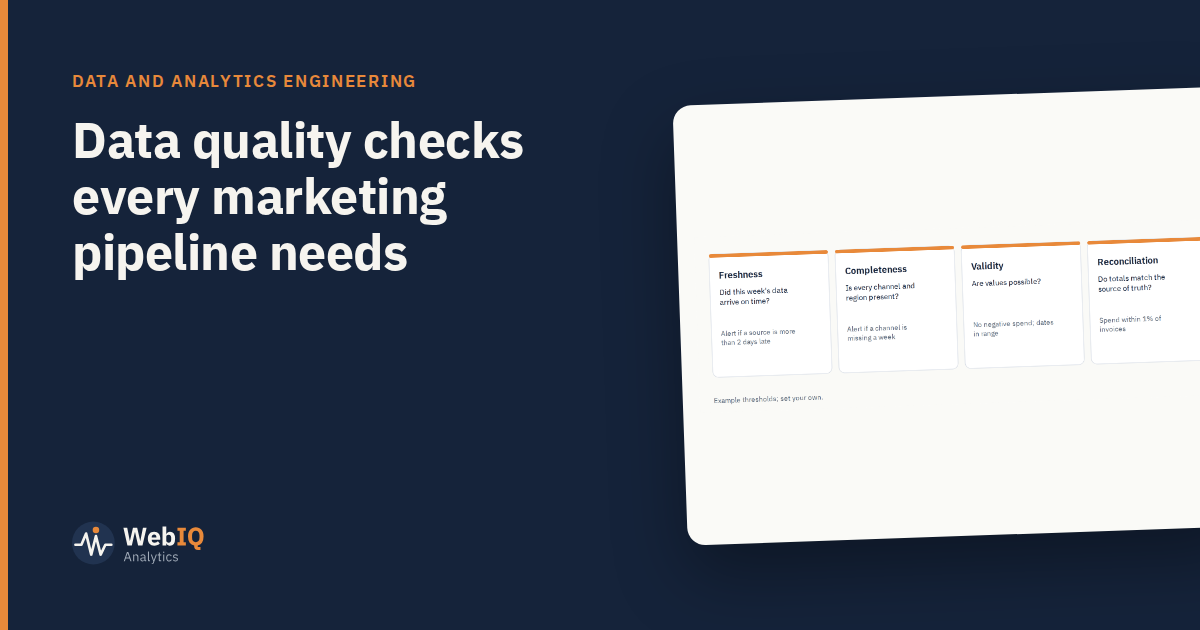
Marketing data breaks quietly: an expired platform token, a renamed campaign, a currency change. The report still renders; it's just wrong. Four kinds of check catch most problems before anyone else does.
1. Freshness
Did this period's data arrive on time? Set an expected arrival time for each source and alert when it's late. A dashboard showing last Tuesday's spend as this week's is worse than one showing nothing.
2. Completeness
Is everything present? Every channel, every region, every week. Missing rows are one of the commonest silent errors, especially after a new campaign or account is added and not mapped.
3. Validity
Are the values possible? No negative spend, no conversions without sessions, dates within range, known channel names only. These are cheap tests that catch broken transformations.
4. Reconciliation
Do totals match a source of truth? Compare weekly spend with invoices or finance figures, and outcomes with the finance system. Agree a tolerance and investigate anything outside it.
Making checks useful
- Alert the person who can fix it, not a shared channel nobody reads.
- Block downstream jobs when a critical check fails, so a broken week never reaches a model or a board report.
- Log every failure and its cause. Patterns show where the pipeline needs strengthening.
- Review thresholds quarterly. Too sensitive and people ignore alerts; too loose and errors slip through.
Where to start
If you have nothing today, start with freshness on every source and a weekly spend reconciliation. In our experience, those two catch most issues that end up in front of leadership.