

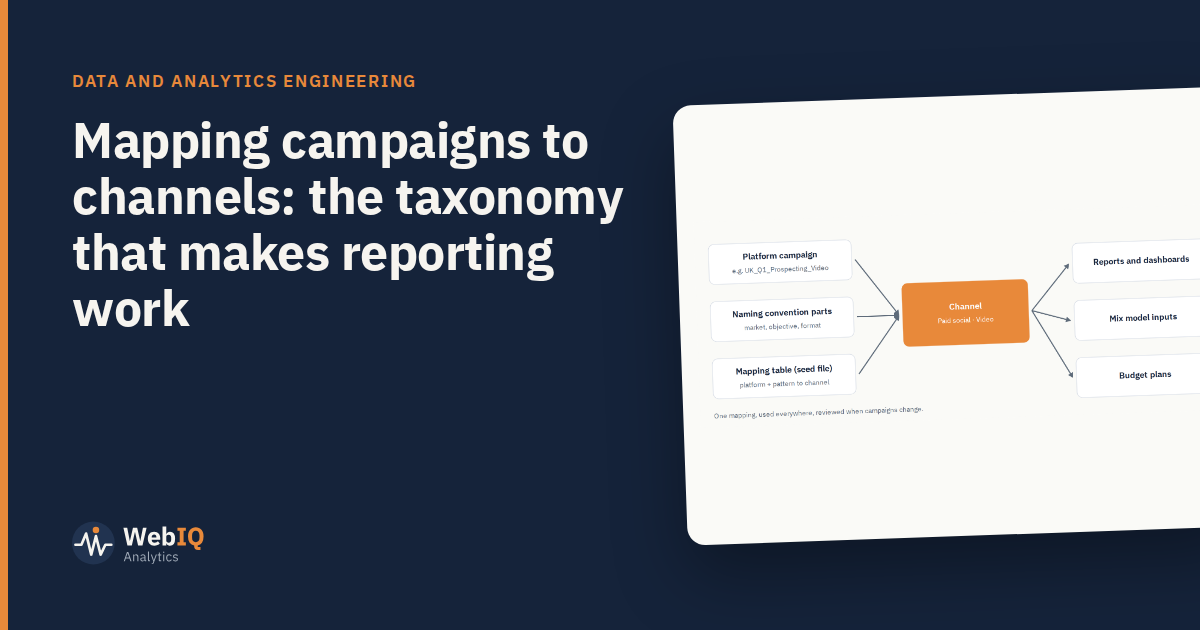
Ask three teams how much was spent on "paid social" last quarter and you'll often get three answers. Each team groups campaigns differently. The fix is a channel taxonomy: one agreed mapping from every platform campaign to a channel, used by every report, dashboard and model.
Decide the channel list first
Keep it at the level decisions are made. Typically:
- Paid search (brand and generic separately)
- Paid social
- Online video
- Display and programmatic
- Affiliates and partnerships
- TV, BVOD, radio, outdoor, cinema and print
- Email and CRM
- Organic (search, social, direct), usually as context rather than paid channels
If budget is set separately for prospecting and retargeting, split them. If not, don't.
Build the mapping table
A simple table with one row per rule:
| Platform | Campaign name pattern | Channel |
|---|---|---|
contains _brand_ | Paid search: brand | |
| everything else | Paid search: generic | |
| meta | any | Paid social |
| youtube | any | Online video |
Store it as a seed file in your warehouse or dbt project, so it's version-controlled and reviewed like code.
Make campaign names work for you
A naming convention that includes market, objective and format makes mapping rules short and reliable. Without one, the mapping becomes a long list of exceptions that breaks with every new campaign.
Check coverage every week
- Unmapped spend: any spend that doesn't match a rule. It should be close to zero and investigated when it isn't.
- New campaigns: list campaigns that appeared this week and confirm their channel.
- Changes: log when a rule changes, because historical numbers can shift.
Own it
Marketing should own the channel definitions; analytics should own the implementation. Agree changes in a short review, not ad hoc.
Where it pays off
The same mapping feeds performance dashboards, finance reporting and the mix model. When everyone uses one taxonomy, numbers reconcile, and discussions move from "whose figure is right?" to "what should we do?".