

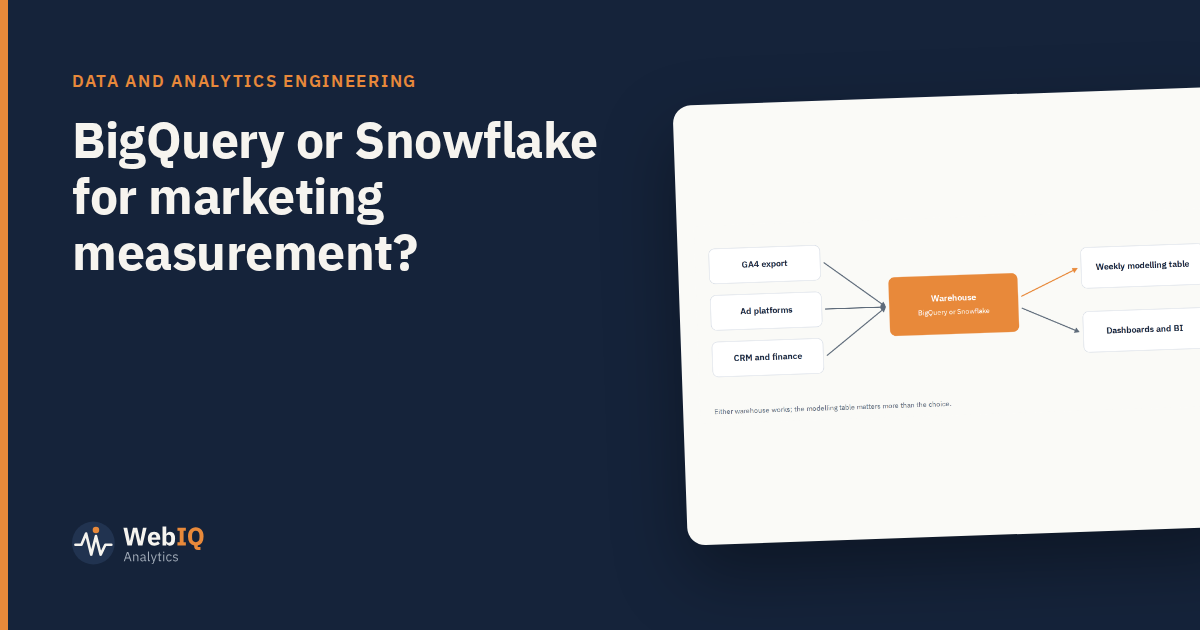
For marketing measurement, the choice between BigQuery and Snowflake matters less than people expect. Both separate storage from compute, scale easily, work with dbt, and connect to the common BI and modelling tools. A few practical differences tend to decide it.
Where your data already lives
- BigQuery has a native GA4 export and close links with Google Ads and the rest of Google Cloud. If your analytics data is mostly Google, it's the path of least effort.
- Snowflake is common where the wider business already runs on it, or on AWS or Azure. Marketing data usually arrives through connectors.
If finance and operations data is already in one warehouse, putting marketing data alongside it often beats any feature comparison. Outcomes and controls live there too.
How you pay
- BigQuery: on-demand pricing by data scanned, or reserved capacity. Cheap for light, irregular workloads; partitioning and clustering keep costs predictable.
- Snowflake: credits for warehouse time, billed while warehouses run. Predictable when warehouses are sized and auto-suspend is set.
For a weekly modelling dataset, both are inexpensive if tables are partitioned by date and queries avoid scanning raw event tables repeatedly.
Who will run it
The team's existing skills, security reviews and procurement often decide faster than benchmarks. A warehouse your data team already knows is worth more than a marginally better one they don't.
What matters more than the choice
- A clean, tested weekly table (see our dbt guide).
- Clear ownership of each source.
- Cost controls set from day one.
Pick the warehouse closest to your data and your team, then spend the effort on the modelling table.