

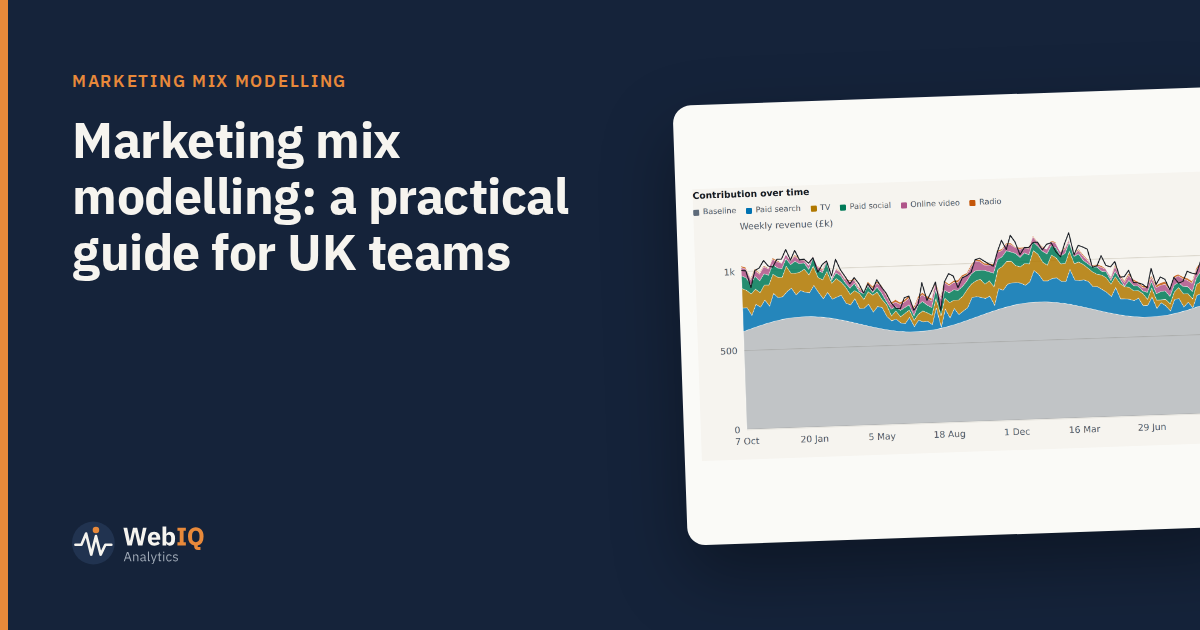
Marketing mix modelling (MMM) estimates how much each marketing channel added to sales, after accounting for everything else that moves sales: seasonality, price, promotions, competitors and the economy. It uses weekly totals rather than individual users, so it works regardless of cookies, consent or tracking gaps.
What it answers
- How much revenue each channel added over a period, with a likely range.
- How much more each extra pound would bring back at today's spend (the marginal return).
- How long each channel keeps working after the spend (carryover).
- Where to move budget at the same total to get more out of it.
What it needs from you
- Two years or more of weekly data: spend by channel, outcomes, and the non-marketing drivers.
- Spend that varies over time. A channel that ran at the same level every week can't be measured from data alone.
- One agreed outcome definition, owned by someone in finance or analytics.
- A list of events: launches, outages, stock problems, anything unusual.
How a good project runs
- Readiness check. Can the data support the questions? Fix gaps first; they're cheaper now than after the model.
- Specification. Agree channels, controls, seasonality and assumptions, and write them down.
- Modelling and validation. Check accuracy on weeks the model didn't see, and look for channels it can't separate.
- Readout. Every number comes with a range, and the caveats are stated in plain English.
- Next steps. Usually a test on the least certain channel, and a refresh schedule.
What you should get back
A readout leadership can act on: contribution and return per pound with ranges, response curves, a reallocation at the same budget, and the uncertainties that matter. You should also get the model itself, documented, so it can be refreshed rather than rebuilt.
When it isn't the right tool
If you need to optimise inside a channel day to day, attribution and platform tools are faster. If you have less than a year of weekly data, or one channel dominates every week, start with the data foundations or a geo test instead.