

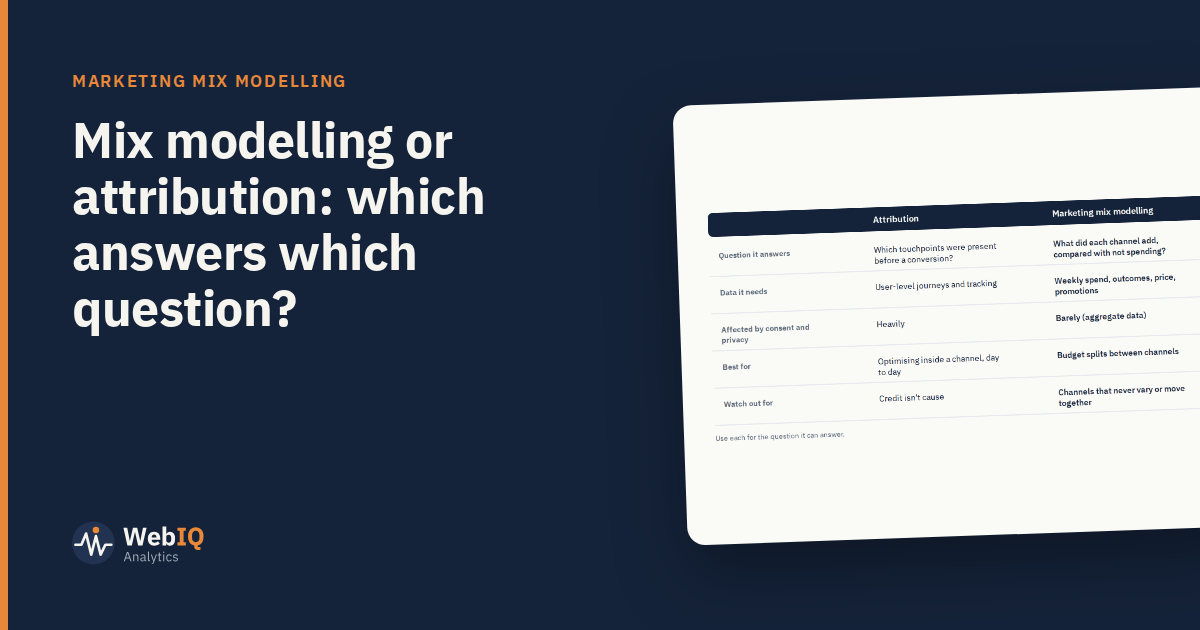
Attribution and marketing mix modelling are often presented as competing ways to measure marketing. They're better understood as tools for different jobs.
Attribution: where conversions were recorded
Attribution follows individual users and assigns credit to the touchpoints before a conversion. Last-click gives it all to the final touch; data-driven models spread it around. It's fast, granular and useful for optimising inside a channel: which keyword, which ad set, which creative.
Its limit is that it measures presence, not cause. Someone who was going to buy anyway still clicks an ad on the way. And as consent rules and browser limits thin user-level tracking, attribution sees less of the journey every year.
Mix modelling: what spend actually added
A mix model looks at weekly totals: spend by channel, outcomes, price, promotions and seasonality. It estimates what each channel added compared with not spending, with a range. Because it uses aggregate data, privacy changes barely affect it.
Its limits are different: it needs history, spend that varies, and care with channels that always move together. It can't tell you which keyword to bid up.
Which to use when
- Budget split between channels: mix model.
- Tactical optimisation inside a channel: attribution or platform reporting.
- The channel you're least sure about: a geo test, then feed the result into the model.
The expensive mistake
Using attribution to set budgets between channels. It tends to over-credit channels close to the purchase (brand search, retargeting) and under-credit channels that build demand earlier. Teams that move budget on attribution alone often cut what was working and scale what was intercepting.
The practical answer is both: a mix model for the big decisions, attribution for the daily ones, and experiments where the two disagree.