

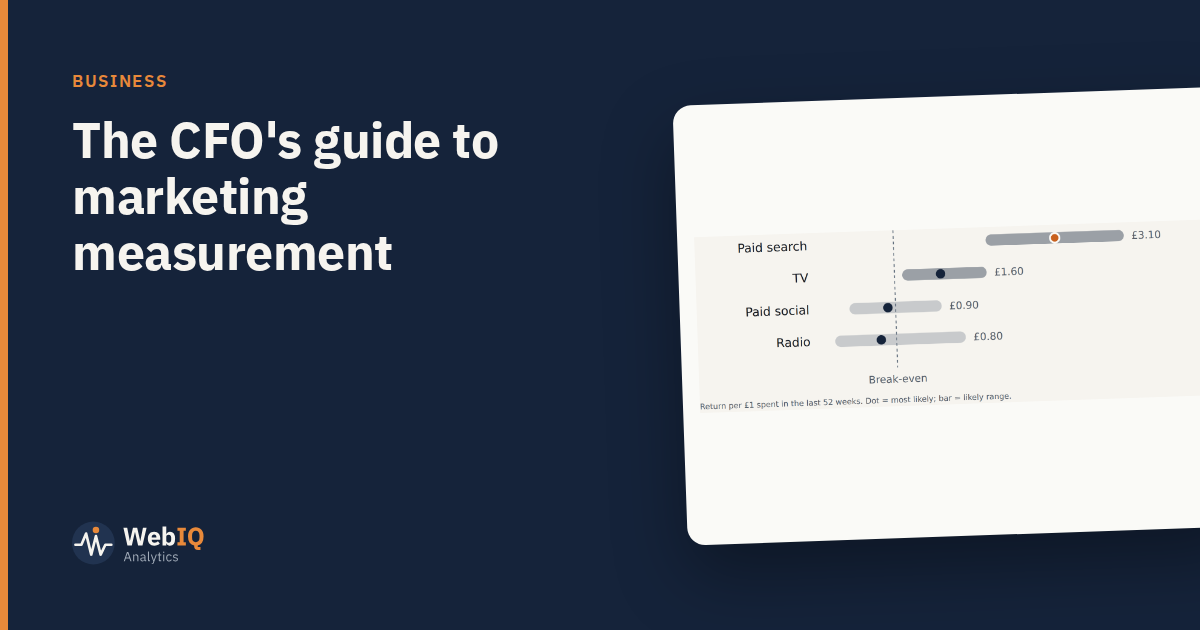
Finance teams are increasingly asked to sign off marketing budgets on evidence they can't easily verify. This guide sets out what to ask for.
The question that matters
Not "what did marketing report?" but "what would have happened without this spend?" Platform reports and attribution answer a different question: where conversions were recorded. For budget decisions, ask for incremental results.
Four questions to ask
- What did we get for the money, compared with not spending it? A good answer gives incremental revenue with a range.
- How sure are you? A good answer gives the range and what it rests on: years of data, checked against an experiment.
- Where should the next pound go? A good answer talks about marginal return, not average return.
- How would we know if you're wrong? A good answer mentions experiments on uncertain channels and forecasts tracked against actuals.
What good measurement looks like
- Mix modelling for the split between channels, with ranges.
- Experiments on the channels the model is least sure about.
- Forecasts with ranges, tracked against actuals every month.
- Clear ownership of data definitions, agreed with finance.
Red flags
- Precise numbers without ranges.
- Every channel showing a strong return.
- Attributed revenue presented as incremental.
- No plan to test anything.
How finance can help
Agree the outcome definition, provide price and promotion history, and accept ranges as an honest feature, not a weakness. The best measurement programmes are run jointly: marketing owns the activity, finance co-owns the standard of evidence.