

Clients increasingly ask agencies for mix modelling, experiments and analytics engineering. Building that capability in-house takes time; partnering can bridge the gap. Choosing the right partner protects both the work and the relationship.
Choose the model first
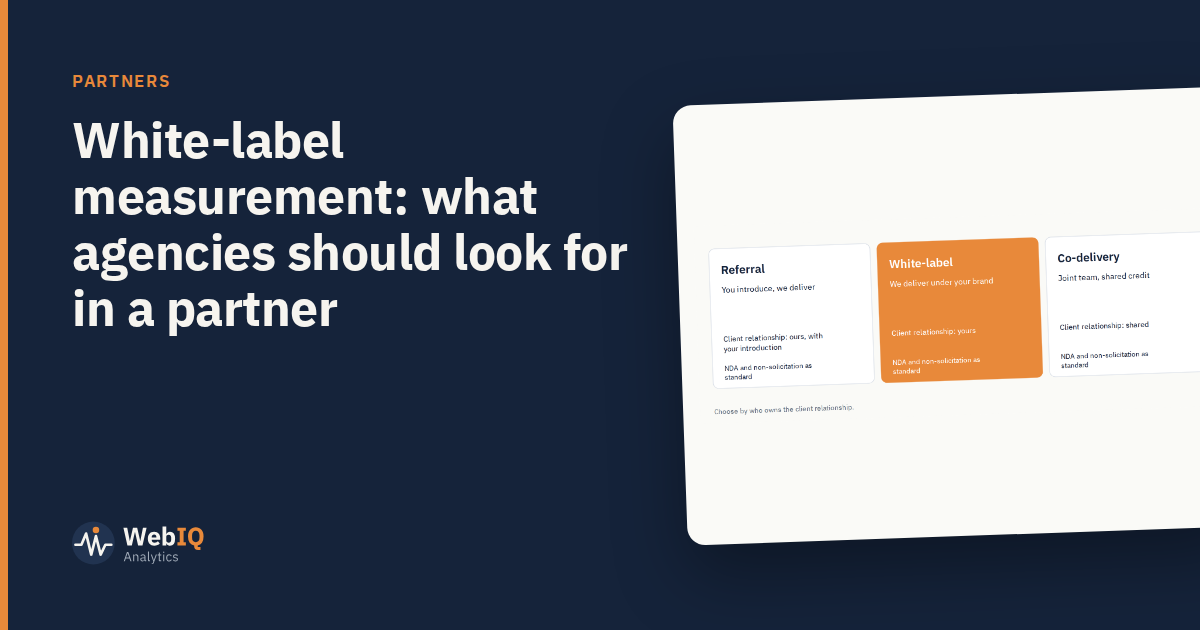
- Referral: you introduce, the partner delivers under its own name.
- White-label: the partner delivers under your brand; you keep the relationship.
- Co-delivery: a joint team with shared credit.
Each has different implications for pricing, branding and who the client calls.
What to look for
- Methods you can defend. Ranges on every number, validation on held-out data, and willingness to say when the data can't support an answer.
- Contractual protection: an NDA and non-solicitation as standard, so the partner never approaches your clients.
- Deliverables in your brand, from reports and slides to documentation, without the partner's marks.
- Hand-over and ownership. The client should keep the model and documentation, not be locked into the partner.
- Transparent process: clear stages, regular check-ins, and access to the work as it happens.
- Fit with your offer. A partner that covers data engineering, implementation and testing, not just modelling, makes joined-up proposals easier.
Red flags
- Black-box methods the partner won't explain.
- Results that always look favourable.
- Pressure to use proprietary tools the client can't keep.
- Reluctance to sign non-solicitation.
Making it work
Agree roles, escalation and quality standards upfront. Run the first project small and well documented. Present the partner's work as yours only when you understand it well enough to answer the client's questions. That's what the client is paying you for.