

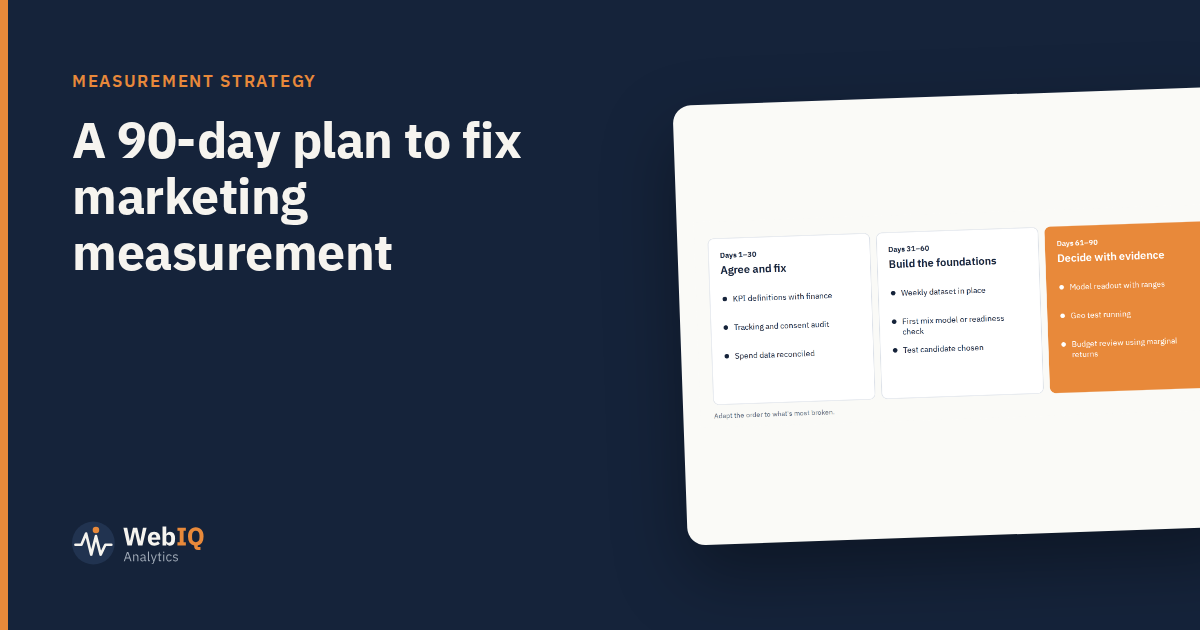
Many marketing teams know their measurement isn't trusted but don't know where to start. This plan covers the first 90 days: fix the foundations, build what's needed, and make one budget decision with better evidence.
Days 1 to 30: agree and fix
- Agree definitions with finance: the outcome, spend and the KPIs that matter. Write them down.
- Audit tracking and consent: key events, consent behaviour, cross-domain journeys.
- Reconcile spend: platform data against invoices, with a channel taxonomy everyone uses.
- List the decisions marketing makes and which method should answer each.
Days 31 to 60: build the foundations
- Build a weekly dataset: spend, outcomes and controls, tested and documented.
- Run a mix model readiness check, and start a first model if the data supports it.
- Choose a test candidate: the channel with the largest budget and the least certainty.
- Design the test: regions, length and placebo checks, agreed before launch.
Days 61 to 90: decide with evidence
- Read out the first model with ranges, caveats and the channels it can't separate.
- Run the geo test, with no peeking.
- Hold a budget review using marginal returns and ranges, making small, reversible moves where evidence is strongest.
- Set the cadence: quarterly model refresh, monthly forecast tracking, a test plan for the next six months.
What success looks like at day 90
- One set of numbers marketing and finance both accept.
- A model with ranges, and a test under way to check it.
- At least one budget decision made with incremental evidence.
- A schedule that keeps it going.
Adapt the order
If tracking is badly broken, spend longer in the first phase. If data is already strong, move faster to modelling and testing. The principle stays the same: definitions first, then data, then methods, then decisions.