

TV and broadcaster video on demand (BVOD) often take the largest share of a brand's budget, yet they're the hardest to measure with digital tools. Nobody clicks on a TV ad. A credible approach combines good data, a mix model built for slow-acting channels, and tests where they're possible.
Get the data right first
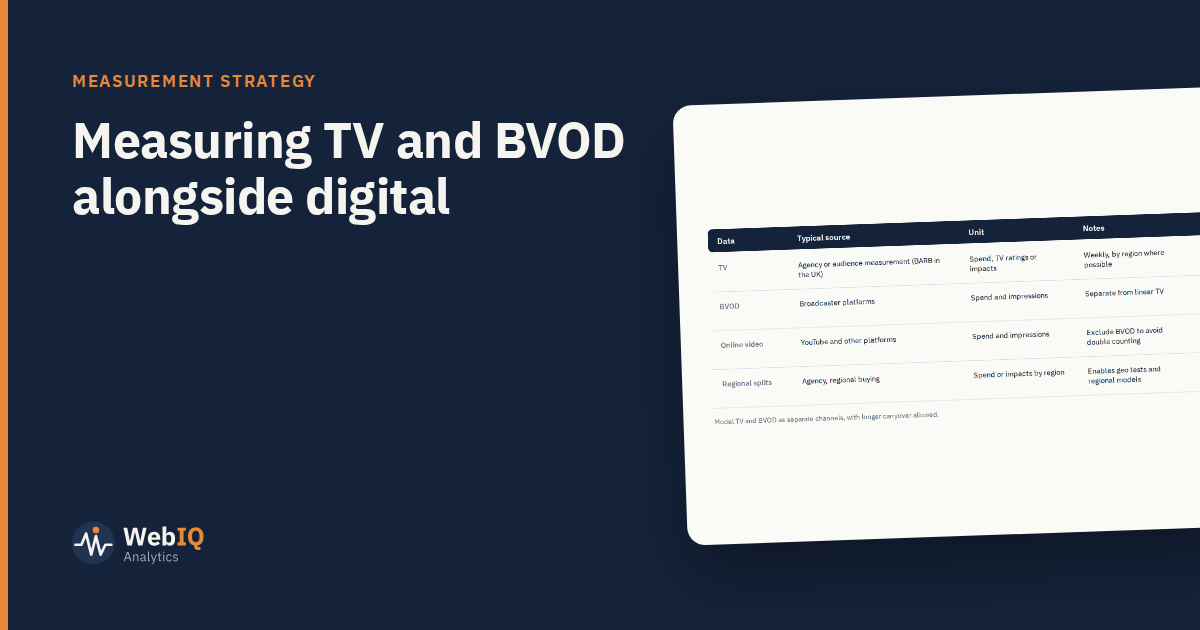
- TV: weekly spend and audience delivery (ratings or impacts) from your agency, based on industry audience measurement (BARB in the UK). Regional splits if you buy regionally.
- BVOD: spend and impressions from each broadcaster platform, kept separate from linear TV.
- Online video: YouTube and other platforms, with BVOD excluded so nothing is counted twice.
Spend alone is fine to start, but audience delivery helps when prices change through the year.
Model them as separate channels
Linear TV and BVOD reach different audiences at different costs. Combining them hides that difference. Give both enough room for carryover: their effects typically build and fade over weeks, not days.
Watch for the usual traps
- TV planned with everything else. If TV always runs alongside paid search peaks and promotions, the model will struggle to separate them. Vary timing where you can.
- Search picking up TV's work. TV drives brand searches; without care, search gets the credit. Check how the model handles brand search.
- Short evaluation windows that miss most of TV's effect.
Test where you can
Regional TV buying makes geo tests possible: go dark or increase weight in selected regions and compare with matched regions. Even one test gives the model a reliable anchor for its largest channel.
Report honestly
TV results usually carry wider ranges than digital channels. Present them that way, with the evidence behind them, rather than forcing a precise figure. Decisions about large TV budgets deserve the most careful evidence, not the most confident number.