

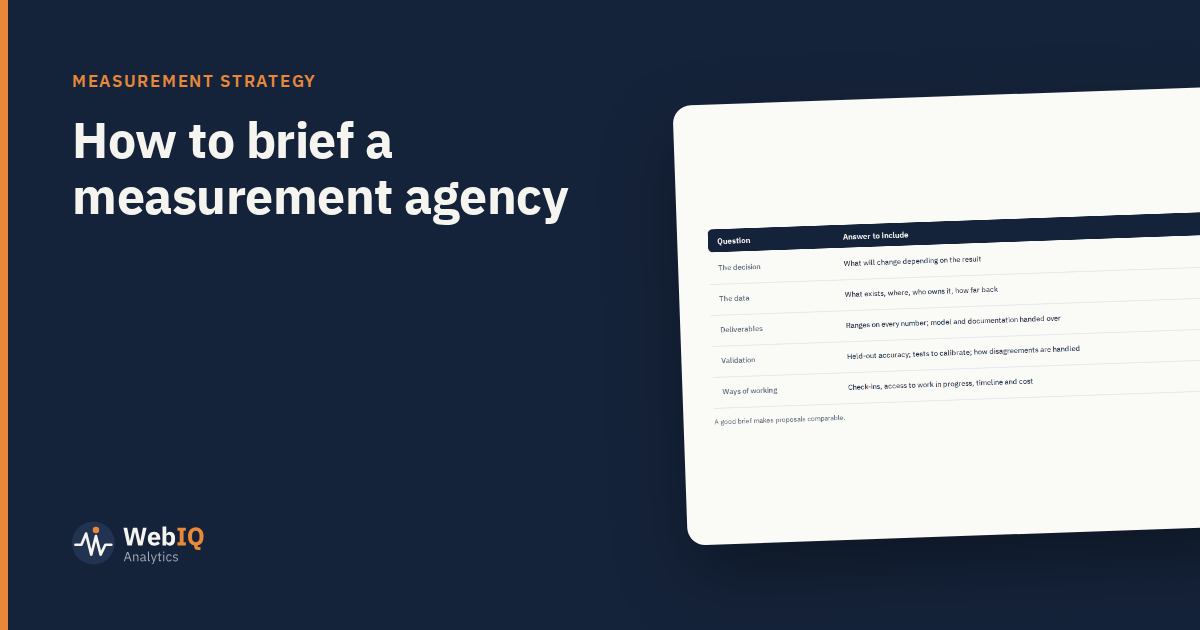
Measurement projects often go wrong at the brief. A vague request ("we need an MMM") gets proposals that can't be compared, and work that answers a different question from the one you had. A clear brief takes an afternoon and saves months.
Start with the decision
What will you do differently depending on the answer? "Decide next year's split between TV, video and search" leads to a different project from "prove paid social works". State the decision, who makes it, and when.
Describe your data honestly
- What exists: spend, outcomes, controls, regional data, tests already run.
- Where it lives and who owns it.
- How far back it goes, and known gaps.
Honesty here gets you realistic proposals. Overstating data quality gets you a cheap quote and a late, expensive project.
Say what you expect to receive
- Results with ranges on every number, not single figures.
- The model, code and documentation, handed over so you can refresh it.
- A readout leadership can follow, with caveats in plain language.
- Recommendations that respect the uncertainty.
Ask about validation
- How will accuracy be checked on data the model didn't see?
- How will results be compared with experiments?
- What happens when the model and a test disagree?
- What will they do if the data can't support an answer?
Agree ways of working
- Who's involved on both sides, and how often you'll meet.
- Access to work in progress, not just the final deck.
- Timeline, milestones and cost, including any refreshes.
Compare proposals fairly
Score each against the same criteria: understanding of the decision, data approach, validation, hand-over and cost. The cheapest proposal that skips validation or hand-over is rarely the cheapest over a year.