

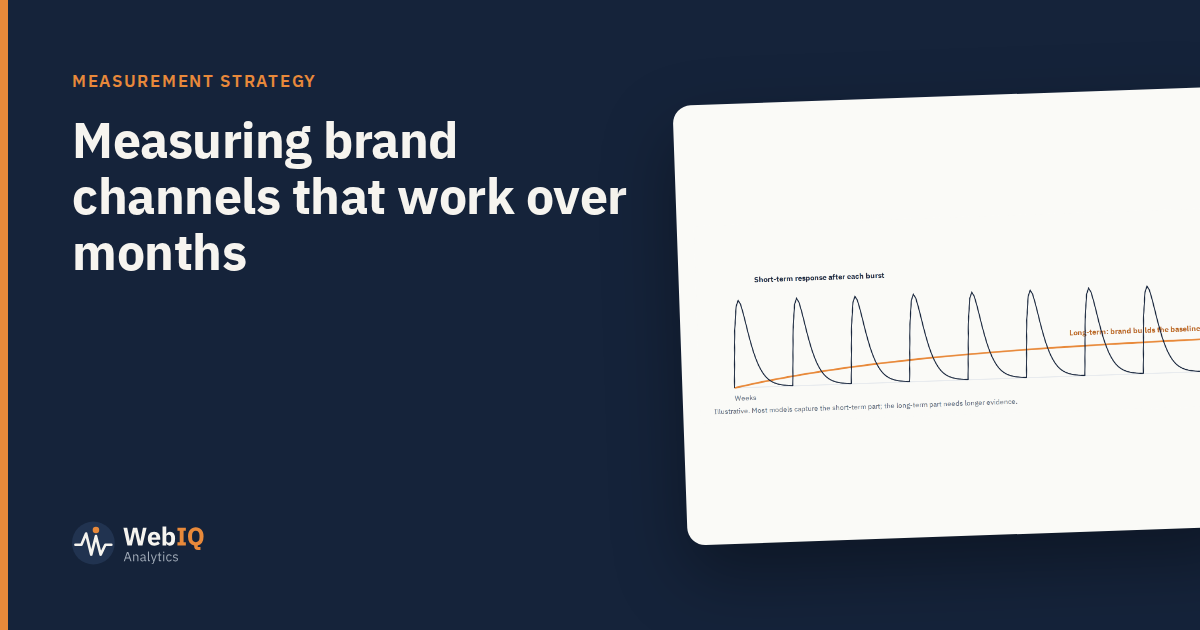
Brand channels such as TV, online video, outdoor and sponsorship work in two ways. They drive some response soon after each burst, and they build a longer-term effect on how often people choose you, which shows up slowly in the baseline. Most measurement captures the first and misses much of the second.
Why short windows undervalue brand
- Attribution and platform reports look at days or weeks after exposure.
- Mix models capture carryover, but usually over weeks or a few months.
- The longer-term effect on baseline demand builds over quarters and years, and is hard to separate from everything else that changes that slowly.
Evidence that captures more of the effect
- Mix models with longer carryover, where the data supports it. Check how far forward the model carries effects and whether brand channels were allowed long enough decay.
- Geo tests that run longer, with readouts at the end of the test and again several weeks later.
- Brand tracking (awareness, consideration, preference) alongside sales, to show the mechanism.
- Long-run analysis of baseline sales against sustained brand investment, treated as directional rather than precise.
Judge brand on the right horizon
Agree in advance how brand activity will be evaluated:
- Short-term sales response, from the mix model, with its range.
- Medium-term effect, from longer carryover and follow-up readings.
- Brand health measures, as supporting evidence.
Don't cut a brand channel because its first-month return looks weak compared with search.
Be honest about uncertainty
Long-term effects are the hardest thing in marketing to measure precisely. Present them as ranges and scenarios, not single numbers, and say which parts rest on direct evidence and which on assumption. Finance will trust a careful range more than a confident figure.